Tuesday, November 8, 2011

Feather 'Forensics': Feathers Can Tell A Story

Feather Forensics:
     Feathers are amazing products of evolutionary technology.  As we now know, feathers link birds to their dinosaurian ancestors.  Looked at through a magnifying lens, feathers show an interlocking system of barbs that predate Velcro by more than 60 million years.  Seen through DNA analysis, they are revealing surprising relationships.  (eg - Falcons are related to Parrots.)  Analyzed chemically, they can reveal pollutants to which birds have been exposed and feathers can reveal the bird's habitat history.  For the amateur scientist or backyard birder, they also have stories to tell.

Common Raven

Feathers and the Law: 
     Unfortunately many birds became endangered or extinct in the last three hundred years, because their feathers made them the target of the fashion industry, the decorative arts, and collectors.  Among the extinct birds who died for their feathers was the Carolina Parakeet.  Those who were endangered by the feather trade were the Western Grebe, the Laysan Albatross, the Snowy Egret, the Spectacled Eider, the Bald Eagle, and the Common Tern.
     Laws protecting migratory birds and raptors were enacted by Congress to keep more species from going extinct.  These laws prohibit the collecting of feathers of these birds, HOWEVER, you can collect molted feathers or bird kills (window hits, predator kills), if you turn them over to the proper agencies:   natural history museums, wildlife centers under the overview of Fish and Wildlife, and authorized biological studies.  
     In this blog, I will tell you how you can make a legal, fake collection and what this collection can tell you.  

Spotted Towhee
Primary Flight Feathers - left wing

Legal Feather 'Collecting':
     My feather collection consists of facsimiles: my watercolor sketches, photos, computer scans, and photocopies.  The feathers can then be returned to nature or given to the appropriate agency.  Using a color copier is the easiest.  It can give amazing results  I have shown these photocopies to people and one or two thought they were real feathers.
     This kind of 'collecting' follows the American Birding Association's code of ethics, that our actions should not endanger birds, other wildlife, or the natural environment. 

Thayer's Gull
Secondary Flight Feather - Right Wing


What Feathers Can Tell You:
     There is an identification book for feathers, appropriately named Bird Feathers, by S. David Scott and Casey McFarland.  It does not have every North American Species, but a good sampling from each region.  I use it, but also use local experts.
           What does the sampling of feathers below show us?  I watched this tree over a five month period.  The Merlin (falcon), usually a male, consistently brought its prey to this tree, where it would pluck off the flight feathers.  Over the five months, by collecting and identifying the feathers, I was able to discover this Merlin's food sources.  These feathers were found on July 7th.  All  feathers were given to the Merlin Falcon Foundation, as part of the Merlin Project.

(feathers seen clockwise from top)
Merlin Feather, Cedar Waxing Feather, & White-Crowned Sparrow Feathers
all found under the same Sitka Spruce tree


The photo, below, was from a dead Swainson's Thrush in my neighborhood.  I had heard what I thought were Swainson's Thrush calls in the dense tree canopy, but they had not shown themselves.  (Bird watchers know that this bird is very secretive and has a beautiful song.)  The body was a kind of sad confirmation.

Swainson's Thrush
predation kill
found near my house

The photo, below, shows a particular type of predation.  The smaller raptors often clip off the wings and tail of their prey.  The wings and tail contain little of nutritional value and make it harder to carry the prey back to their perch, mate, or young.  If the body is missing and the clipped wings are scattered on the ground this is what you might be seeing. 

Varied Thrush
predation kill
also found in my neighborhood

The picture of the Northern Flicker shows a new feather erupting from its feather sheath.  These feathers are sometimes called blood feathers, because there is arterial flow into the growing feather shaft.  When the feather is fully formed, the blood is withdrawn from the artery and the artery withers.  Pre-fledging juveniles are particularly vulnerable, because all of there new feathers are going through this phase.  If these feathers are broken before they are fully formed the bird is put in jeopardy from blood loss.  It is important that pre-fledge juveniles are not put in danger by our actions.

Northern Flicker
predation kill
found in the Lake City District of Seattle
This was a mature bird regrowing a feather lost to molting.

Colors in feathers are generally produced by pigments or by structure.  The orange-red colors in the Northern Flicker feathers come from carotenes, the same pigment that colors carrots!  The browns and black colors come from melanins, the same pigment that gives us humans our wonderful pigments.  The blues in the wing color bar of the Mallard, below, do not come from pigments.  They are derived from the way the light interacts with the feather, itself.  The same is true for most birds with blue feathers.

Male Mallard Duck
Lake Terrell, Whatcom County
cause of death unknown
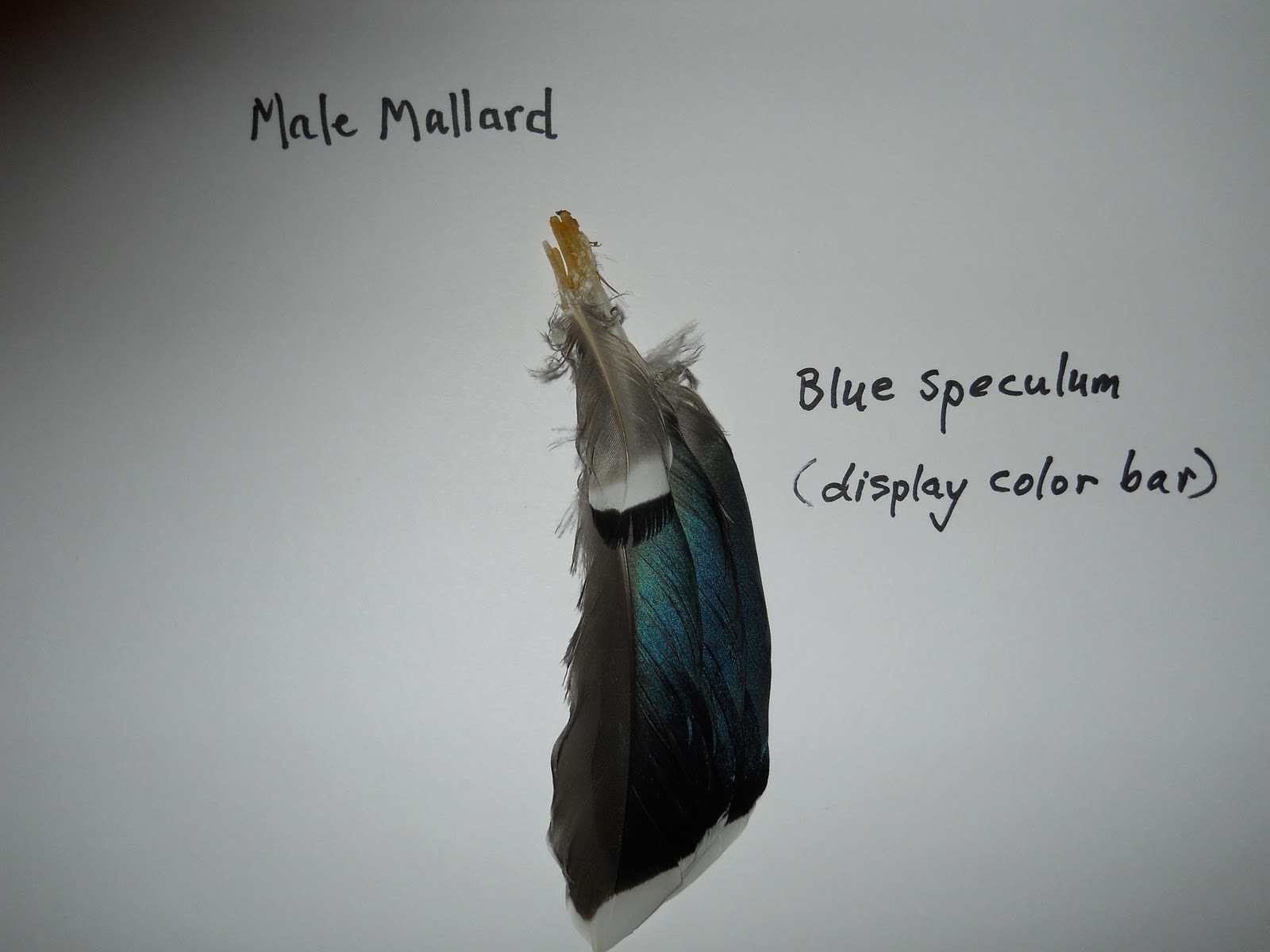
If you find a molt feather, note its condition.  Feathers get rough treatment from sun and friction.  They are kept in shape as long as possible by careful preening and the application of oil from the uropygial gland or 'preen gland' found at the rump.  If you see a preening bird sticking its bill at its rump/base of tail, it is getting oil to apply.  This is exactly like you putting on sunscreen.  If you are a duck, this preening keeps you afloat and waterproof.  
     Still, birds like the Red-Tailed Hawk have a rough and tumble life.  Taking down prey, like a mouse or a snake, they flatten their wings and tail against the ground, surrounding their kill.  By the next molt, these feathers often have a raggedy look.   
Red-tailed Hawk
Molted Tail Feather

You can learn a whole lot by observing feathers.  Sometimes bird watching means looking down, not up.


Tuesday, November 1, 2011

Fall Migration at Semiahmoo and Birch Bay

      Autumn is bringing winter southward.  I've found that one way to stay aware of the changes is to keep a journal.  Another is to keep a dedicated calendar.  For example, today, I saw a female Downy Woodpecker and female Northern Flicker at my suet feeder and they became calendar entries.  After a full year, you will begin to see a 'parade of species':  like when the Russula Mushrooms sprout under the Douglas Firs, when the Black-Tailed Deer fawns have lost their spots, when the Coho Salmon have returned,  and so on... 

     One of the great seasonal changes occurring now is the fall migration of birds.  On October 27, I went to Birch Bay and a few miles further north to Semiahmoo Spit (which protects a bay on the US-Canada border) to observe the return of waterfowl that had summered in the Arctic.  If you live along the coast in Oregon or California, you may see some these same birds later this fall or winter.  I feel both awe and wonder when I think of their annual round-trip journeys!  

      One familiar sight right now is V formations of Canada Geese.  I recently came back from a road trip and saw large V flights of Canada Geese in the San Joaquin Valley, California.  Many Canada Geese, however, will stay as resident populations.  Our Canada Geese will be joined by thousands of Trumpeter Swans, Snow Geese and Black Brants (a small goose) in November.

(Please note, these photos were made with a camera, held up to a spotting scope.)

Canada Geese preening and foraging for eel grass
that has washed ashore.
- more than 90 at Birch Bay -


     This day, I talked to an 'old timer' from Birch Bay.  She told me that the numbers of migratory ducks and geese and shore birds has been declining since she started watching in the 1970s.  Later, another birder at Semiahmoo told me the same thing.  Our journals can help provide an historical perspective that is desperately needed for ecological awareness.

Canada Goose preening


     One of the seasonal changes that can be seen is the change in plumage.  The brilliant feathers of the breeding season are being replaced with non-breeding, winter plumage... more subdued and probably providing more camouflage.  I found it interesting that the males who still had their breeding colors were conspicuously still paired with their mates.  On the other hand, males in winter plumage or juvenile plumage were sometimes in flocks of mixed species.
     If you wish to learn to identify these birds, it is important that your field guide has pictures of both breeding and non-breeding phases.  I suggest a regional field guide if you are new to an area, not an 'all-the-birds' book.  Comprehensive field guides include many species you may never see.  For those who live in this area, I recommend Birds of the Puget Sound Region, by Morse, Aversa, and Opperman.

Dabbling Ducks:   Among the dabbling ducks I saw this day were Pintails, Mallards, and American Wigeons.

Northern Pintail Duck


The Pintail is a dabbler, not a diver.  It feeds on water plants by dipping its head down under, with its tail sticking up.  Like other dabbling ducks, they feed in the shallows.  Other dabblers seen this day were Mallards and American Wigeons.  You are more likely to see the dabbling ducks closer to the shore, in the more shallow water.

American Wigeons at Semiahmoo


American Wigeons at Birch Bay's Creek


Diving Ducks:  Like the name says, diving ducks are at home swimming under water for food.  Many eat crustaceans, mollusks, and small fish.  Harlequin ducks frequent marine environments like these in the winter, but move into mountains - inland and north - in breeding season.  If I had to pick one duck as the most beautiful, I would choose the Harlequin.  This day, I also saw a mated pair of Golden-Eye Ducks and a mated pair of Buffleheads.  Both species are also diving ducks.  

Harlequin Ducks


Diving Sea Ducks:  This day at Semiahmoo, I saw Scaups and Scoters...ducks at home in a marine environment.  I still cannot distinguish a Greater Scaup from a Lesser Scaup, so lets just say that I saw fewer than ten scaups.  Large flocks of scoters rafting at Birch Bay and Semiahmoo both numbered over one-hundred.

Surf Scoters


Surf Scoters showing white nape spot


White-Winged Scoters
White secondary feathers show in the spread wing display


Pair Bonding Displays:  Many species of ducks maintain their pair bonds even when breeding season is over.  It was fascinating to watch mated-pair-strengthening behaviors in both Mallards and in White-Winged Scoters.  I watched one Mallard pair bobbing their heads in unison.  Another Mallard pair and White-Winged Scoter pair did a 'dance' that went something like this:  Head Dip in Water (HDW)-HDW-HDW-HDW, followed by rising up out of the water and flapping wings. (See above.)  This was followed by the male and female 'pair swimming'.    

Loons and Grebes:   Loons are not related to ducks and geese (Anatidae) but belong to a different avian family, Gaviidae.  They are a good indicator species for polluted water.  They require pristine waters for breeding and nesting.  They are amazing divers, staying underwater up to a minute, while making dives of over one-hundred feet.  All the loons I saw were in their non-breeding plumage.

Common Loon
Non-Breeding Plumage


Loon fishing


Loon eating its catch, probably a crustacean


Grebes:  The grebes are also diving birds.  This day, they were actively fishing.  They were also in their winter plumage.

Western Grebe


Horned Grebe - Winter Plumage


Shore Birds:  The Dunlins, a kind of sandpiper, are gathering in flocks. Their breeding grounds were on the shores of the Arctic Ocean, 2,500 miles to the north of the US-Canada border.  They are always in motion, running along the shore, flying in tight flock formation every minute or so.  The amount of energy expended must be incredible.  Some of that energy will be transformed as they become prey to Peregrine Falcons and Merlins.    
Dunlin


Small Flock of Dunlins
about 120 - 140 birds


The Ever Adaptable Crow:  Of course, I saw crows.  Two excellent books on these scrappy, intelligent, social, opportunistic birds are:  In the Company of Crows and Ravens, by John M. Marzluff and Tony Angell and Crow Planet, by Lyanda Lynn Haupt.
   
American Crow


Questions or Comments?:  rogersfieldjournal@yahoo.com

Monday, October 24, 2011

Trees: A Key to Understanding Birds

Once you learn the names of the trees around you, your understanding of birds will increase.  Your field notes will take on greater depth if you identify the trees where the birds are carrying out their activities.  You may find, for instance that Winter Wrens are understory birds, not canopy birds.  You might get Eureka moments such as these:  "Hmmm, Bald Eagles tend to perch and nest in Cottonwoods in this region."  "That's the third time I've seen Brown Creepers foraging for insects on on the main trunks of Douglas Firs."  "Snags around here show excavations by Northern Flickers and Pileated Woodpeckers."
     Of course, these are not 'laws' of fixed behavior.  They are behavioral tendencies that will help you understand the ecosystem that sustains the bird.

Adult Bald Eagles in a Cottonwood
Lummi Reservation, WA
Below: Black Cottonwood
Populus trichocarpa


Below: Adult Bald Eagle at Edison, WA


The age of trees is also a factor in bird behavior.  For instance, the Marbled Murrelet, a seabird, must nest atop old growth conifers, like the giant Douglas Fir shown below.  Spotted Owls also depend on 'old growth'.  This may lead you to question if changes in forest composition (by forestry, agriculture, and urbanization) will have an effect on these and other birds.  Which birds are adapting to urban 'forests'?  Which birds are failing to adapt?  Your observations may help in long-term studies and conservation decisions.

You probably cannot estimate the tree's age, but you can tell its diameter.  The bigger the diameter, the older the tree!  Forest botanists measure the tree at four and a half feet above the ground, in centimeters (DBH: diameter at breast height).  The old growth Douglas Fir, below, is nearly four meters in diameter at DBH!  Since Douglas Fir tree rings are from 2 to 5 centimeters wide on the stumps I have seen, that makes the tree at least 400 years old.  The lichen, Lobaria oregana, that I found near the tree, is another indicator of a mature or an old growth forest.     

Old Growth Douglas Fir
Pseudotsuga menziesii


Lettuce Lungwort
Lobaria oregana
An indicator of old growth trees

Recognizing the trees and shrubs in your habitat will allow you to see patterns in avian behavior.  You can relate this behavior to tree species with the five Ws: Who, What, Where, When, and Why.  Look where birds spend most of their 'tree-time':  the crown and upper canopy?  the lower branches and understory?  the forest floor?  In the open?  Do they prefer certain species for specific activities?  Do they avoid certain species of trees?  Does the maturity of the tree matter?

HERE ARE FIVE CONIFERS THAT SERVE AS BIRD HABITATS IN BELLINGHAM.


Above:  Douglas Cedar Cone and Needles


Above:  Red Cedar
Thuja plicata


Above:  Western Hemlock
Tsuga heterophylla


Above:  Grand Fir
Abies grandis
Cones are upright, like all true firs


Above:  Sitka Spruce
Picea sitchensis

 Learn the trees and the web of life will not just be an abstract concept to you.  For me, observing ecologically means:
- learning the habitats in this region.
- learning the plants (especially trees and shrubs) in those habitats.
- journaling species interactions, whether they be Boletus Mushrooms, Banana Slugs, Birch Trees, or Bushtits.  
-using the 5 Ws: Who, What, Where, When, and Why.


If you would like to read more about old growth trees, I highly recommend the National Geographic October 2009 article called "The Tallest Trees: Redwoods".  

Tuesday, October 18, 2011

Shorthand for Field Notes


Do you think bird watching is just identifying and checking birds off a list?  Start looking at birds' behaviors, interactions, and interdependence with the environment.  Start a field journal.  It will turn you into a naturalist.  A great book to help encourage you to become a naturalist is Crow Planet, by Lyanda Lynn Haupt.  The book is partly about corvids (Crows, Ravens, Jays, Magpies), but the theme running through it is that you can be a naturalist.  David Sedaris called this book, "A completely charming and informative book on the pleasures of keeping your eyes open."

"But the only bird I can recognize is a Crow!"

Crow at Port Townsend

If you want to be an amateur biologist or naturalist, then you've got to start observing and recording, no matter if the only bird you can recognize is a crow.  If that is so, then look at crows!  They're interesting.


Crows at a garbage dumpster in Alaska

Journaling to Remember

I suggest carrying a small notebook and mechanical pencil with you.  I carry a notebook that allows me to write on rain-resistant paper.  Have an expectation that you may see some wonderful episode of nature unfolding.  Be ready to write what you see, because our memories are far from perfect.

For example, in this picture, below, I took notes on a curious interaction.  This occurred in the raptor center in Sitka, Alaska, two years ago.  The raven behind the fence, in the cage, was doing the solicitation gesture (vibrating the wings) for the wild, larger raven outside the cage.  It was also trying to push the piece of meat through the wire screen to its wild, potential friend.  This was in the spring, at the height of mating season, which may explain the behavior.  If I hadn't written these notes in my handy notebook, I probably would have forgotten some of the details of the encounter, by now.  


Captive Common Raven (behind screen) attempting to feed a wild Common Raven (on near side of screen).  Corvids are sociable and intelligent.

Sketching to Remember

My field journals are full of sketches and cartoons that quickly remind me of the action I am seeing.  For me, at least this is a better mnemonic than writing.  Sibley, whose field guides on birds are exceptional, suggests that we make quick sketches on how different birds fly.  For example, if I wish to show that the raven, below, is soaring and not flapping its wings, I will write CORA (Common Raven) with an arrow and a direction indicator (like NE) and  a diagonal line, /, across the arrow to symbolize outstretched wings and soaring.  Later, I can add words in my field notes.


Above: Raven in flight

Invent a Shorthand

Things happen fast in nature... too fast for writing in sentences.  Having a shorthand helps.  For the Merlin Project, described in the October 15th blog, all my field notes are standardized to conform to the chief researcher's codes.  This is a Merlin observation in code.  Your notebooks don't need to look like this!
Below:
This says that at 5:31 AM a male Merlin 'flutter flew', while vocalizing ("Kee-Kee-Kee-Kee").  He flew to the a Douglas Fir (Pseudotsuga menzesii), which served as a prey-exchange tree.  His female mate met him and he delivered the prey to her.  Then, she flew to a Sitka Spruce (Picea sitchensis), acting as a pluming tree, where she pulled feathers from the prey.  The male, then flew silently and quickly to the Southeast, out of sight (OSS).

For my personal field journals, I've developed my own, more casual 'short hand'.  It is based on the 5 Ws of journalism:  Who/What/Where/When/Why?  Here's an example:
Above:
This tells me that eight American Crows (AMCR) mobbed a Red-tailed Hawk (RTHA) and drove it from a Red Cedar, about 200 meters to a Cottonwood, and from there, out of sight (OOS).  This happened at dusk, behind my house.  It probably happened because the Red-tail was perched in the flight path of the crows as they flew to their evening roost and because crows mob raptors that may pose a threat.  Notice, my field notes are based on the 5 Ws: Who is involved?; What's happening?; Where did it happen?; When did it happen?; Why might it have happened? ('Why?' leads to your best guess based on observation... an hypothesis.)

I suggest that you develop your own shorthand.  After a while, you will start to see patterns of behavior and get a deeper understanding and appreciation of your bioregion.  


If you show as much curiosity as a Common Raven or an American Crow and you regularly take notes in the notebook you always carry with you, nature will reward you with new insights.

Saturday, October 15, 2011

Merlins and Reading Nature

Over the past two years, volunteering with the Merlin Falcon Foundation, I've had at least 50 people ask me about that 'Merlin' or 'falcon' or 'little hawk' that was hunting birds in their garden or near their bird feeders.  Most often, when people thought they were seeing a Merlin (falcon), they were actually seeing a juvenile Sharp-Shinned Hawk, or sometimes a juvenile Cooper's Hawk, trying to get an easy meal.  I recently painted the picture, above, to show the differences between the Coastal Forest Merlin (Falco columbarius suckleyi) and the Sharpies.


Merlins, by Audubon

Look first at the eyes.  The Merlin's eyes are a dark, chocolate brown, surrounded by a yellow orbital circle and a light brow.  The Sharp-Shinned Hawk's eyes are a pale yellow when young, becoming more orange and reddish as an adult.  Now look at the breast and belly.  Our resident Merlins are darkly streaked while the juvenile Sharpies are lightly streaked and the adults are reddish-barred.  Look now at the tail.  The Sharp-Shinned Hawks have longer tail feathers with easy to see black bars.

Merlins are beautiful birds - energetic, amazing hunters of passerines (small perching birds), and good parents to their young.  They are also stealthy.  Most people I have talked to have never seen Merlins, even if a family nested near them.  The dark brown or almost black hue of their feathers blends in with the dark greens of Sitka Spruce, Western Hemlock, firs, and cedars.  In the canopy, they are almost invisible.

You will likely hear a Merlin before you see it.  If they are calling to their mate or fledged young or chasing off a large predator like a Bald Eagle, you will hear a fierce sounding Kee-Kee-Kee-Kee.  Look up quick above the tree canopy and you may see the avian equivalent to a jet plane.


female Merlin waiting for the male to bring food


female eating food brought by male


female doing post-copulation preening 


male watching over nest sight from a safe distance


post-fledging juveniles waiting for parent prey delivery

I believe in non-invasive field studies, where the birds can carry out their migratory, mating, and breeding activities without interference.  That's why I got involved in the 25 year long field study being conducted by the Merlin Falcon Foundation.  Check out their website, if you want to learn more of their life activities or hear vocalizations or get involved yourself.

When I first moved to this bioregion seven years ago, the birds and the forest flora were as unintelligible to me as a partly learned foreign language.  I was familiar with chaparral and oak forest ecology, found in regions South.  With time and patience, you can learn the 'language' of your local ecosystem.  You can learn to read nature and you can share those insights with others.  In the next posting of this blog, I will give some hints on keeping a field journal and I'll highlight another regional bird species.